 日本語
日本語 English
A. We will guide you through the maintenance method for cup-and-cone bearing pedals.
Important Notes
- Please note that any pedals maintained or adjusted by yourself will not be covered under the warranty for initial defects.
- If you feel unsure about performing the work yourself, we recommend consulting a local bicycle shop or a professional shop. Additionally, paid repair services are available through us upon request; please feel free to contact us.
- The information provided here is current as of June 2026. Discontinued past products and limited-edition items are omitted.
Cup & Cone Bearings
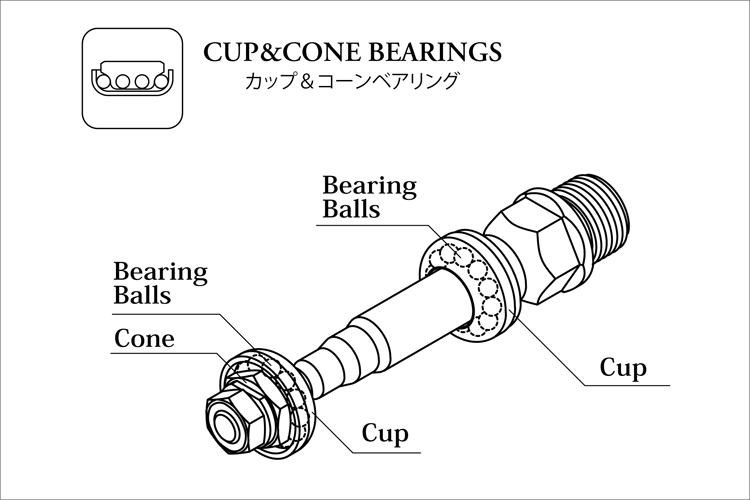
1. Items to Prepare Before Work
- Items for Cleaning and Greasing
・Rags (Cloth)
・Parts cleaner
・Grease (NLGI Grade 2 multipurpose grease or similar high-retention grease) - Tools for Attaching/Detaching Pedals and Holding the Spindle
15mm pedal Spanner (MKS Pedal Spanner PT-1 / Touring Spanner PT-2).
Or various Allen keys (Hex wrenches)
*Some discontinued products use Allen keys (Hex wrenches) only.
*The 3000S / 3000R and some discontinued products use a 15mm pedal wrench (MKS Pedal Spanner PT-1/Touring Spanner PT-2).
Note: Ezy / Ezy Superior products require a 16mm wrench to hold the spindle. - Tools for Attaching/Detaching the Cage *Only for pedals where the access hole is covered by the cage.
Various Hex wrenches.
*The FD-7 / FD-7 WIDE and some discontinued folding pedals require a 3mm pin punch and a hammer.
*The cage cannot be removed from the BM-7 / MT-LITE / MT-LUX COMPE and some discontinued pedals. - Tools for Attaching/Detaching the Cap Please refer to the table below
Model Required Tools G-6000 / GRAFIGHT-XX / PB-50 / PB-370 / PB-430 / Seahorse / ROYAL NUEVO / EXA / LAMBDA / GAMMA / Pretzel / RMX / Aurora / MT-LUX COMPE 75 / ESPRIT / UB-LITE / MT-E / AR-2 / TOURING-LITE / PROMENADE / CT-LITE / IC-LITE / GR-9 / GR-10 Pick tool
Or
Small flathead screwdriverSYLVAN Series (except NEXT / MASH STREAM Series / BM-7 MKS Cap Spanner XC-Ⅲ 6mm Hex wrench 3000S / 3000R 8mm spanner - Tools for adjusting bearings See the table below.
Model Bearing Size Required Tools SYLVAN Series (except NEXT) / MASH STREAM Series / FD-7 / FD-7 WIDE / G-6000 / GRAFIGHT-XX / PB-50 / PB-370 / PB-430 5/32" MKS 5/32 BEARING ADJUSTER PT-3
Or
12mm and thin-walled 15mm socket wrenches3000S / 3000R 5/32" 12mm and thin-walled 15mm socket wrenches BM-7 5/32" 12mm Spanner Seahorse / ROYAL NUEVO / EXA / LAMBDA / GAMMA / RMX / MT-E / AR-2 / TOURING-LITE / PROMENADE / CT-LITE / IC-LITE / GR-9 / GR-10 / Aurora / MT-LITE / MT-LUX COMPE / MT-LUX COMPE 75 / ESPRIT / UB-LITE / Pretzel / XC-Ⅲ / RUNBER-X 1/8" MKS 1/8 BEARING ADJUSTER PT-4
Or
10mm and thin-walled 13mm socket wrenchesUX-D/Panamax 1/8" 10mm and thin-walled 13mm socket wrenches MT-LITE/MT-LUX COMPE 1/8" 10mm offset wrench
2. Removing the Pedals
- Apply the appropriate tool to the pedal spindle. Loosen and remove the right pedal by turning it counterclockwise, and the left pedal by turning it clockwise.
*If the pedals are tight and difficult to remove, apply penetrating lubricant to the pedal threads from the back of the crank arm and wait a while before attempting again.
3. Disassembling the Pedal Body
- For pedals where the access hole is covered by the cage, remove the cage using the appropriate tool.
*For the FD-7 / FD-7 WIDE and some discontinued folding pedals, place a 3mm pin punch against the pins on the cage and tap them with a hammer to push the pins out. - Remove the cap using the appropriate tool.
- Use a 15mm pedal spanner, the appropriate Hex wrench, or a vise to hold the pedal spindle securely and prevent it from rotating.
- Loosen and remove the locknut using the appropriate bearing adjustment tool listed above, then remove the washer. Next, loosen and remove the cone nut.
*For the FD-7 / FD-7 WIDE and some discontinued folding pedals, both the locknut and cone nut on the left pedal have left-hand (reverse) threads. - Carefully pull out the spindle, ensuring that the bearing balls do not drop or scatter.
- Remove all the bearing balls.
4. Cleaning and Replacement
- Clean the pedal spindle, inside of the pedal body, cone nut, and bearing balls using rags and parts cleaner.
- Completely remove all old grease and dirt, then wipe off any remaining moisture thoroughly.
- Check the pedal spindle, cups inside the pedal body, cone nut, and bearing balls for wear, scratches, or pitting. Replace them if any abnormalities are found.
*Replacing the cups is extremely difficult; therefore, the entire pedal body generally needs to be replaced. - Always replace the locknut and washer with new ones, regardless of their condition.
- Please contact an authorized MKS pedal dealer regarding the availability of replacement parts.
5. Greasing and Reassembly
- Apply an appropriate amount of new grease to the two cups inside the pedal body, and place the bearing balls into the cup on the crank side.
*Use 11 bearing balls per cup for 5/32" size, and 12 bearing balls per cup for 1/8" size.
*Do not use bearing balls of a different size than those specified for the model. - Insert the spindle carefully, making sure the bearing balls do not drop out.
*Depending on the condition, applying a thin layer of grease to the spindle can help prevent rust. - Place the bearing balls into the cup on the cap side.
*The application of grease and the order of placing the bearings may vary as long as the components are correctly positioned. - Install the cone nut by turning it either by hand or with the appropriate bearing adjustment tool until it lightly touches the bearing balls.
*Do not overtighten it at this point, as overtightening may damage the components. - Install the washer on top of the cone nut. There is no distinction between the front and back of the washer.
- Install the locknut by turning it either by hand or with the appropriate bearing adjustment tool until it lightly touches the washer.
*Do not overtighten it at this point, as doing so may damage the components depending on the position of the cone nut. - Rotate the pedal spindle by hand to ensure there is no heavy, rough resistance, and check that there is only a minimal, barely noticeable amount of play (looseness) in the spindle. This is a temporary setup before tightening the locknut. If it is not in the correct state, adjust it by slightly loosening or tightening the cone nut.
- Use a 15mm pedal spanner, the appropriate Hex wrench, or a vise to hold the pedal spindle securely and prevent it from rotating.
- Tighten the locknut to the specified torque using the appropriate bearing adjustment tool.
・Pedals with 5/32" bearings: 8.8–11.7 N·m
・Pedals with 1/8" bearings: 5.9–8.8 N·m - Slowly rotate the pedal spindle with your fingers to check for any play and to inspect the smoothness of the rotation. The ideal condition is when there is no play in the spindle throughout its entire rotation, and the rolling resistance of the bearing balls is kept to a minimum.
- If the condition is not ideal, secure the pedal spindle again using a 15mm pedal wrench, Hex wrench, or a vise, and make fine adjustments using the appropriate bearing adjustment tool.
・If play is felt: Tighten the locknut further without exceeding the specified torque.
・If heavy, rough resistance is felt: Turn the cone nut in the loosening direction (which locks it tighter against the locknut) without exceeding the specified torque.
*For products with non-removable side plates (cages), the cone nut cannot be turned with a tool. Therefore, adjustment can only be made by tightening the locknut. - Slowly rotate the pedal spindle with your fingers again to check for play and the smoothness of the rotation.
- Repeat the fine adjustment and inspection steps above until the ideal condition is achieved.
If you cannot achieve the ideal condition within the specified torque range using the method above, loosen the locknut, finely adjust the position of the cone nut, and restart the adjustment process from the locknut tightening step. - Once you confirm that the pedal spindle rotates smoothly with no play and minimal resistance, the bearing adjustment is complete.
- Install the cap using the appropriate tool.
*If the cap was removed using a pick tool or a small flathead screwdriver, push it back into place by hand.
6. Final Check
- Slowly rotate the pedal spindle with your fingers to ensure that the rotation is smooth and free of any catching or binding.
- When reinstalling the pedals onto the bicycle, thoroughly clean the threads of both the pedal spindle and the crank arm. Apply grease to the threads, pay close attention to the correct threading direction for the left and right sides, and tighten them securely.
- Wipe off any excess grease or dirt cleanly.